
Senator George Akume, CON, Chairman of the LIFC National Steering Committee and Secretary to the Government of the Federation (centre); Governor Babajide Sanwo-Olu, CON, Co-Chairman of the LIFC National Steering Committee and Governor of Lagos State (5th left); Aigboje Aig-Imoukhuede, CFR, Chairman, EnterpriseNGR and Co-Chairman of the LIFC Council (5th right); Obi Ibekwe, Chief Executive Officer, EnterpriseNGR (2nd row, 8th from right); Lami Adekola, Director Policy and Public Affairs, EnterpriseNGR (2nd row, 10th from right); Anthony Bidokwu, Head of Corporate Communications and Branding, EnterpriseNGR (2nd row, 7th from right); and federal ministers, permanent secretaries and other senior government officials during the inauguration of the LIFC National Steering Committee on September 2, 2026, in Abuja. ABUJA, Nigeria – September 2, 2026 EnterpriseNGR has recorded a major milestone in its ongoing efforts to establish the Lagos International Financial Centre (LIFC) following the Federal Government’s endorsement as a strategic national economic priority and inauguration of the LIFC National Steering Committee. At the inaugural meeting of the LIFC National Steering Committee in Abuja on Wednesday, the Federal Government affirmed President Bola Ahmed Tinubu’s endorsement of the LIFC as a strategic national economic priority to enhance Nigeria’s position globally, attract investment and support long term economic growth. The National Steering Committee brings together the Federal Government, Lagos State government and the private sector represented by EnterpriseNGR to coordinate the legal, regulatory, fiscal, investment promotion, immigration and digital infrastructure requirements necessary to successfully establish a globally competitive financial centre. The LIFC was initiated by the Lagos State Government in partnership with EnterpriseNGR and has evolved extensively marking the initiative from design and planning towards full scale implementation. Inaugurating the Committee, the Secretary to the Government of the Federation, Senator George Akume, CON, reaffirmed President Bola Ahmed Tinubu’s support and stated that the Office of the SGF has been directed to coordinate Federal Government support for the initiative. He highlighted the opportunity for Nigeria to leverage Lagos’ strategic position and economic potential to build a financial centre of international standing. Governor Babajide Sanwo-Olu, CON, Chairman of the LIFC Council, described the Centre as “strategic national infrastructure”, emphasising that the initiative should be viewed not simply as a Lagos project, but as an instrument of Nigeria’s long-term economic strategy. The Governor also highlighted the broader ambition of the initiative is to establish the Lagos International Financial centre as a trusted gateway through which global capital can access opportunities in Nigeria and across the continent. EnterpriseNGR has played a central role in the development of the initiative, convening perspectives from across Nigeria’s Financial and Professional Services sector and ensuring that industry expertise remains embedded in the Centre’s design and implementation process. Through sustained engagement with stakeholders across the sector, EnterpriseNGR continues to support the creation of a financial centre aligned with international standards and investor expectations. Speaking at the inauguration, Chairman of EnterpriseNGR and Co-Chairman of the LIFC Council, Aigboje Aig-Imoukhuede, CFR, emphasised the importance of institutional alignment in attracting global capital and driving economic transformation. He described the collaboration between the Federal Government, Lagos State and the private sector as an example of what can be achieved when institutions align around a shared economic objective. “Capital is perhaps the most discerning visitor that I know,” he said, emphasising that investors ultimately gravitate towards jurisdictions where they feel safe, where rules are predictable and where opportunities can grow. That principle is central to the LIFC’s development. Extensive preparatory work has already been completed, including the development of the Centre’s strategic blueprint, legal and regulatory assessments, business planning and institutional design. Specialist workstreams are also advancing legal and regulatory reforms, institutional capability and the international positioning of the Centre, with KPMG supporting the Project Office and TheCityUK providing international technical support funded by the UK Government. The Attorney-General of the Federation and Minister of Justice, Mr Lateef Fagbemi, SAN, pledged support for the legal reforms required to provide greater certainty for investors, while the Nigeria Revenue Service and Ministry of Industry, Trade and Investment emphasised the need to develop a model suited to Nigeria’s constitutional, legal and economic realities. The Ministry of Foreign Affairs also committed to supporting the Centre through investment diplomacy, international advocacy and strategic partnerships. The LIFC is now working towards a soft launch in the first quarter of 2027. For Nigeria, the significance of the LIFC extends beyond Lagos. Its broader objective is to channel global capital into productive opportunities across the country and the wider African market. A successful Lagos International financial centre has the potential to deepen capital markets, strengthen professional services, create high-value employment, increase investment and mobilise long-term capital into critical sectors of the economy, including infrastructure, technology, agriculture and manufacturing. With Federal Government backing now firmly established, Lagos State providing jurisdictional leadership and EnterpriseNGR keeping the Financial and Professional Services sector embedded in the process, the LIFC is moving into its most consequential phase of turning strategy into an institution that investors trust and businesses use. About the Lagos International Financial Centre (LIFC) The Lagos International Financial Centre is a collaborative initiative of the Federal Government of Nigeria, Lagos State Government and the private sector, represented by EnterpriseNGR to establish an internationally competitive financial centre in Lagos and position Nigeria as a trusted gateway for global capital seeking opportunities across Nigeria and Africa.

Category: Media & Events
EnterpriseNGR Graduates YOE Cohort VI, Champions “Active Citizenship” Among Nigeria’s Next Generation of Leaders

Cohort VI graduates of EnterpriseNGR’s Youth of Enterprise (YOE) Internship Programme, celebrated at a virtual graduation ceremony on Thursday, 13 August 2026. EnterpriseNGR, Nigeria’s leading advocate for the Financial and Professional Services (FPS) sector, has celebrated the graduation of 86 young Nigerian professionals from the sixth cohort of its flagship Youth of Enterprise (YOE) Internship Programme. The virtual ceremony, held on Thursday, 13 August 2026, was themed “Active Citizenship: Impact on Career and Leadership Development.” Since its launch in 2022, the YOE programme has impacted almost 3,000 young Nigerians, equipping them with workplace readiness, professional development, mentorship and training to thrive in Nigeria’s evolving world of work. The graduation ceremony was moderated by Anthony Bidokwu, Head, Corporate Communications and Branding, EnterpriseNGR, and featured addresses from notable speakers including Obi Ibekwe, CEO of EnterpriseNGR; Dr. Abraham Owoseni, Learning and Development Expert and Principal Consultant at Mind Mode, who delivered the keynote address; and Adedoyin Owolabi, Vice President, Human Capital at Chapel Hill Denham, who shared an employer’s perspective on the programme. The graduation ceremony featured addresses from notable speakers including Obi Ibekwe, CEO of EnterpriseNGR; Dr. Abraham Owoseni, Learning and Development Expert and Principal Consultant at Mind Mode, who delivered the keynote address; and Adedoyin Owolabi, Vice President, Human Capital at Chapel Hill Denham, who shared an employer’s perspective on the programme. Speaking at the event, Obi Ibekwe, CEO, EnterpriseNGR, said: “Completing this programme is not an end; it is the beginning of a new chapter in your professional journey. Since its 2022 launch, the Youth of Enterprise Internship Programme has impacted almost 3,000 young Nigerians, helping democratise access to opportunity regardless of location, background, or personal connections.” She urged the graduates to remain lifelong learners, pursue excellence, and support others on their own growth journeys. Delivering the keynote address, Dr. Abraham Owoseni, Learning and Development Expert and Principal Consultant at Mind Mode, challenged the graduates to embrace active citizenship as a catalyst for career success, economic growth, and communal impact: “Leadership begins with contribution, not position. The real question is this: will you simply consume the value you have received through this programme, or will you multiply it for others?” In her remarks, Adedoyin Owolabi, Vice President, Human Capital, Chapel Hill Denham, shared her organisation’s experience as an employer partner: “We took in three interns from Cohort VI, and we went on to employ two of them permanently.” She attributed the hiring decisions to qualities the interns demonstrated, including curiosity, willingness to learn, receptiveness to feedback, and a deliberate approach to work, and encouraged the graduating cohort to look beyond simply securing employment, focusing instead on the value they can create, the problems they can solve, and the communities they can positively influence. The event also featured testimonials from graduates, who shared how the programme transformed their confidence, workplace readiness, professional skills, and career prospects. Several participants described the experience as pivotal in helping them transition successfully into the corporate environment and secure employment. As part of the celebration, EnterpriseNGR recognised outstanding performance within Cohort VI through awards and cash prizes, honouring its top-performing groups and graduates based on aptitude assessments, engagement levels, project contributions, and masterclass participation. Stella Nwihim, Head of Programmes, EnterpriseNGR, said: “Every member of Cohort VI is a winner and a future nation-builder.” EnterpriseNGR used the ceremony to encourage more organisations to join the programme as employer partners. Employer partners give graduates workplace access, practical experience, feedback, and the opportunity to demonstrate their potential, while gaining access to a pool of young Nigerian talent that has been screened, trained, and assessed before placement. The graduating interns undertook placements in reputable organisations such as Access Bank Plc, Aig-Imoukhuede Foundation, Chapel Hill Denham, Coronation Group, Coronation Merchant Bank, Coronation Securities, Custodian Investment Plc, Ecobank Nigeria, EnterpriseNGR, Fiducia Capital Limited, Providus Bank, and Trium Limited; a testament to the strong industry partnerships that continue to power the YOE Initiative. The ceremony celebrated the achievements of Cohort VI, whose stories of growth and resilience embody the mission of EnterpriseNGR’s Youth of Enterprise initiative: to tackle youth unemployment by bridging skills gaps and preparing young Nigerians for thriving careers. Applications and the waitlist for YOE Cohort VII will open soon. Interested graduates and prospective employer partners can learn more and join the waitlist at enterprisengr.com/yoe. About Youth of Enterprise (YOE) Youth of Enterprise (YOE) Internship Programme is an initiative of EnterpriseNGR that aims to address the problem of unemployment and underemployment in Nigeria. Since 2022, the organisation has empowered almost 3,000 young Nigerians nationwide with employability skills to position them for success. About EnterpriseNGR EnterpriseNGR is a dynamic, member-led organisation at the forefront of championing the advancement of the Nigerian Financial and Professional Services (FPS) sector. With a steadfast commitment to fostering a conducive policy environment, EnterpriseNGR advocates the growth and development of all FPS sub-sectors, including Banking, Insurance, Capital Markets, Asset Management, Pensions, Non-interest Finance, FinTech, Professional Services (Legal Services, Accounting and Management Consulting), and Sustainable Finance, to position Nigeria as Africa’s premier financial centre.
July 2026 YOE Masterclass: Artificial Intelligence – Use Cases in the Financial and Professional Services Sector

“AI will not replace you, but a professional effectively using AI will.” This was the defining takeaway from the latest edition of the Youth of Enterprise (YOE) Masterclass, held on Saturday, July 25, 2026. It was a hands-on, forward-looking session tackling one of the most talked-about shifts in today’s workplace: Artificial Intelligence: Use Cases in the Financial and Professional Services Sector. The masterclass was facilitated by Dr. Ibukunoluwa A. Ayodeji, Chief Information Officer at Optimus Bank Nigeria. A seasoned specialist in emerging technologies, enterprise architecture, digital transformation, and IT service management, Dr. Ayodeji brought over 20 years of progressive IT leadership, banking operations, and consulting experience to the session. Holding a Doctorate in Applied Information Technology from Walden University (USA), a Master’s degree from the University of Lagos, and a Bachelor’s in Electrical and Electronics Engineering, he delivered a master-level roadmap for turning technical AI concepts into everyday workplace advantage. From the outset, Dr. Ayodeji framed AI as an execution multiplier rather than a replacement for talent, challenging participants to move past passive curiosity and start using AI as a daily partner in professional delivery. Here are the key insights from the session. 1. Where AI Is Already at Work: Sector-Specific Use Cases Dr. Ayodeji opened by breaking down how AI is already deployed across core corporate functions, giving participants concrete examples of how to shift from manual processing to strategic oversight: Legal & Compliance: AI-powered document parsing lets legal and compliance professionals instantly synthesise dense regulatory policies, cross-examine contracts for clause anomalies, and draft baseline agreements, freeing up time for strategy, risk mitigation, and negotiation. Finance & Accounting: Optical Character Recognition (OCR) and predictive models now scan receipts, auto-reconcile invoices, and flag variances in real time, shifting the professional’s role from entering numbers to interpreting financial narratives and advising on strategic allocation. Human Resources & Talent Acquisition: Automated candidate screening evaluates resumes against job descriptions, schedules pipeline touchpoints, and parses skill maps, dramatically reducing recruitment cycles while maintaining consistency. 2. Practical Frameworks for Daily Practice To ensure participants left with tools they could apply immediately, the session outlined two operational frameworks for daily use. The Prompt Engineering Workflow To get actionable results from generative AI tools, Dr. Ayodeji encouraged professionals to move away from generic queries and apply a structured, four-part prompt framework: Low-Compute & Localized AI Strategies Addressing internet bandwidth and infrastructure constraints common in local markets, Dr. Ayodeji highlighted practical alternatives: TinyML & Offline Models: lightweight AI tools designed to run on minimal processing power and local storage, without needing constant high-speed internet. Voice-to-Data Pipeline: converting raw audio, such as recorded client meetings or trade voice notes, into structured, searchable text databases using localised speech-to-text engines. Localized Dialects & Context: language tools trained on regional dialects and African contexts to improve communication accessibility and customer onboarding across diverse demographics. 3. Positioning Yourself as an “AI Asset” in Your Career Adopting technology is as much about strategic career positioning as it is about efficiency. Dr. Ayodeji outlined three actionable habits for standing out in any organisation: The 30-Minute Daily Practice: dedicate 30 minutes every day to experimenting with prompt frameworks, testing automation tools, or learning workflow integrations relevant to your industry. Small, continuous iterations build technical mastery over time. Upward Value Creation: senior executives often lack the time to test emerging digital tools. Using AI to draft reports, structure meeting notes, or conduct preliminary market research helps you support leadership faster and become an indispensable resource. The Human-AI Balance: technical speed must be balanced with human judgement. AI accelerates production, but personal integrity, critical thinking, and emotional intelligence are what build long-term career credibility and executive trust. 4. AI Governance, Ethics, and Regulatory Compliance A crucial portion of the session focused on safety, compliance, and responsible AI usage within highly regulated industries like finance: Avoid the “Blind Copy-Paste” Trap: AI outputs must always undergo human verification. You remain fully accountable for the accuracy, logic, and factual correctness of anything you submit. Data Privacy & Confidentiality: never input proprietary corporate data, customer personally identifiable information (PII), or confidential financial records into public, unencrypted AI models. Regulatory Alignment: always operate within established legal frameworks, including the Nigeria Data Protection Regulation (NDPR), NITDA guidelines, CBN cybersecurity frameworks, and global standards like ISO 42001 for AI management. Key Takeaways from YOE July 2026 Masterclass AI Is a Strategic Multiplier: shift your mindset from viewing AI as a novel tool to treating it as an essential coworker that handles routine execution while you focus on high-level strategy. Structure Drives Quality: the quality of an AI’s output is directly tied to the clarity, role definition, and context provided in your prompt. Governance Is Non-Negotiable: speed should never compromise data privacy, regulatory compliance, or strict verification of outputs. Continuous Action Yields Mastery: true digital transformation happens through daily, small-scale practice, not passive learning. In Conclusion The July 2026 YOE Masterclass was an empowering call for young professionals to move beyond theory and take hands-on control of tech-enabled career growth. Through sector-specific case studies, practical prompt frameworks, and clear governance principles, Dr. Ibukunoluwa A. Ayodeji equipped attendees with the exact tools needed to elevate their productivity in Nigeria’s financial and professional services sector and stand out as modern digital assets. Stay Connected with Us Don’t miss out on upcoming masterclasses, professional growth content, and internship opportunities. Follow the Youth of Enterprise (YOE) community across all our active channels: Instagram X (formerly Twitter) Facebook TikTok Telegram Missed our previous sessions? Catch up on the key insights from the June 2026 Masterclass on Personal Effectiveness: Growing Beyond Your Comfort Zone.
June 2026 Masterclass on Personal Effectiveness: Growing Beyond Your Comfort Zone

Growth rarely happens when we’re comfortable. That was one of the key takeaways from the June 2026 YOE Masterclass, “Personal Effectiveness: Growing Beyond Your Comfort Zone.” The session was facilitated by Mr. Chris Akeju, Head of the Operational Risk Team at Union Bank of Nigeria, who shared practical insights on what it truly means to grow intentionally in today’s fast-paced professional environment. Mr. Chris challenged participants to rethink personal effectiveness. Rather than viewing it as a personality trait, he described it as the deliberate alignment of our values, goals, and daily actions. In other words, effectiveness is not something that happens by chance—it is something we intentionally build. Understanding the Four Zones of Growth One of the session’s most impactful lessons was the concept of the Four Zones of Growth. According to Mr. Chris, professional growth begins with understanding where you currently are and having the courage to move forward. The first zone is the Comfort Zone—the place where everything feels familiar and predictable. While it may feel safe, staying here for too long can lead to stagnation, as there is little room for learning or development. Beyond that lies the Fear Zone, where self-doubt, insecurity, and the fear of failure often show up. Many people find themselves stuck here because they are overly concerned about what others think or are afraid of making mistakes. The good news is that growth begins in the Learning Zone. This is where we take on challenges, develop new skills, and gain valuable experiences. It can be uncomfortable, but it is also where real progress happens. Finally, there is the Growth Zone—the place where purpose, confidence, and achievement come together. Here, individuals continuously set new goals, expand their capabilities, and pursue opportunities that align with their aspirations. For interns and young professionals, the message was simple: don’t let fear keep you from taking the next step. Whether it’s speaking up during a meeting, volunteering for a presentation, or learning a new skill, growth often starts with one uncomfortable decision. Making Better Use of Time The conversation then shifted to one of our most valuable resources: time. Mr. Chris shared a powerful perspective on the relativity of time and how its value depends entirely on the situation. For a student, a single year can make the difference between graduating on time or repeating a class. For an athlete, a fraction of a second can separate a gold medal from second place. To help participants manage their time more effectively, he introduced the Eisenhower Matrix, a simple but powerful framework for prioritisation. A major takeaway from this segment was the importance of intentionally creating time for activities in Quadrant Two. The more time we invest in growth and preparation, the less time we spend reacting to crises. Lessons in Audacity and Going the Extra Mile The masterclass came alive through two memorable case studies that demonstrated what can happen when people choose to move beyond limitations. The first was the Brussels Airlines customer service story, which showed how a flight crew went above and beyond standard service expectations to create a meaningful experience for a passenger. It was a reminder that true professionalism is not just about completing tasks—it is about creating value and leaving a lasting positive impression on others. The second was the inspiring story of Max Fox’s audition on Britain’s Got Talent. After waiting 19 years for an opportunity to perform, Max stepped onto the stage and delivered a memorable performance of My Way. His story highlighted the importance of preparation, courage, and believing in yourself even when opportunities seem far away. For participants, the lesson was clear: when opportunity finally arrives, preparation gives you the confidence to seize it. In Conclusion The June 2026 Masterclass reminded us that personal effectiveness is not a destination—it is an ongoing journey of growth, learning, and intentional action. As participants reflected on the session, four key action points stood out: Step beyond your comfort zone and embrace opportunities to learn. Invest more time in growth-focused activities before they become urgent. Develop the audacity to take action even when the outcome is uncertain. Look for ways to exceed expectations and create meaningful value for others. Stay Connected with Us Don’t miss out on upcoming masterclasses, professional growth content, and internship opportunities. Follow the Youth of Enterprise (YOE) community across all our active channels: Instagram X (formerly Twitter) Facebook TikTok Telegram Missed our previous sessions? Catch up on the key insights from the May 2026 YOE Masterclass: Social Media Etiquette
EnterpriseNGR Members’ Night in Pictures

At EnterpriseNGR Members’ Night 2026, we brought together business leaders, policymakers, and key stakeholders to strengthen relationships and drive meaningful conversations on the future of Nigeria’s Financial and Professional Services (FPS) sector. Under the theme Strengthening Nigeria’s Insurance Sector: Insights for Growth, Stability, and Inclusion, we officially launched the State of Enterprise (SOE) 2026 Report, sharing key insights into the insurance sector and its role in driving economic resilience, trust, and inclusion. The evening provided an opportunity to exchange ideas, foster collaboration, and reinforce our commitment to advancing thought leadership and supporting the long-term growth and competitiveness of Nigeria’s FPS sector.
Recognising Potential Beyond Academia: Fatima Kesington on Youth Development, Career Growth, and Skills-Based Education

“I will always be motivated by the need to find purpose in whatever I do, to contribute to solutions rather than simply complain about problems.” – Fatima Folorunsho Kesington, Principal Consultant, Process Inherent For Fatima Folorunsho Kesington, impact begins with purpose. A Business Integrator and Business Operations Consultant with over 13 years of experience, she has built her career around solving problems, creating value, and enabling growth. As Principal Consultant at Process Inherent and co-founder of a boutique consulting firm, she has worked across the private, public, and development sectors, helping organisations align purpose with profitability while driving sustainable growth. A Kashim Ibrahim Fellow, certified Project Management Professional (PMP), and accredited Business Development Service Provider, Fatima is a strong advocate for youth development, lifelong learning, and skills-based growth. Creating Opportunities for Young Professionals to Thrive For many young professionals, interviews can be intimidating, particularly when entering the workforce for the first time. Fatima understands this reality well. “It is never easy to sit for an interview, especially if it is the first one ever for some of them. I am hoping that I make it a bit less nerve-racking, so they have the clarity to focus on the quality of their responses during the interview rather than on the anxiety that the process brings.” This people-centred approach reflects her belief in creating spaces where individuals can perform at their best and confidently demonstrate their capabilities. Why Nigerian Youth Are Driving Innovation and Workforce Adaptability Through her interactions with YOE interns, Fatima has developed a deep appreciation for the resilience and adaptability of Nigerian youth. What impresses her most is their determination to succeed despite the challenges they face. “Their tenacity. Their inspiring ability to absolutely make lemonade. The odds are stacked, so they are very intentional about not putting all their eggs in one basket, career-wise.” She observes that many young people understand that career paths are no longer linear. Rather than limiting themselves to one professional identity, they are increasingly willing to learn new skills, explore different industries, and adapt to changing realities. Fatima believes this entrepreneurial mindset is one of Nigeria’s greatest strengths. With the right support, mentorship, and opportunities, young people can transform their resilience into innovations and solutions that drive economic and social progress. As the future of work evolves, she sees Nigerian youth continuously demonstrating the adaptability and resourcefulness needed to succeed in a rapidly changing world. Career Development: Why Adaptability Matters in Today’s Workforce When asked what advice she would offer young professionals seeking long-term career success, Fatima emphasises: Flexibility Curiosity and Continuous Learning. “Your career path does not have to be carved in stone; you may end up making an impact very far away from what you initially thought you wanted to do.” She encourages young professionals to remain open to opportunities beyond their immediate areas of expertise, noting that exposure to different functions can broaden perspectives and strengthen problem-solving abilities. She also believes that developing a genuine reading culture is essential. “Hone a reading habit, not as a social media challenge but as a genuine quest for knowledge outside your niche. It enriches conversation and stretches the mind.” For Fatima, career growth extends beyond acquiring technical skills. It is equally about cultivating the curiosity, versatility, and adaptability needed to navigate an increasingly dynamic workplace. In an era where industries are constantly evolving, professionals who commit to lifelong learning are better positioned to remain competitive, seize emerging opportunities, and contribute meaningful value wherever they work. She believes that success belongs to those who remain teachable and open to growth. Closing Nigeria’s Skills Gap Through Education and Industry Collaboration Fatima offers an insightful perspective on the ongoing conversation around youth development, employability, and workforce development in Nigeria. Rather than placing the responsibility solely on employers, she argues that addressing the skills gap requires a broader rethink of how society defines success and equips young people for the future of work. She believes that many Nigerian youths have been deprived of meaningful choices between pursuing professions and pursuing vocations, with academic pathways often receiving greater recognition than practical skills and technical expertise. “We have exalted theoretical skills to the detriment of practical skills whilst a combination of both is essential to drive economic development.” Fatima advocates increased investment in trade schools and polytechnics, viewing them as vital institutions for innovation, industrial growth, workforce development, and skills acquisition. She believes that restoring dignity and value to vocational education can unlock new opportunities for employment while strengthening national productivity. She also highlights the need for stronger collaboration between academia and industry to ensure tertiary education curricula reflect the evolving demands of the labour market. “A close synergy between academia and organisations will ensure that the right skills and knowledge necessary for national progress shape tertiary education curricula.” By aligning education more closely with industry realities and workforce demands, she believes institutions can produce graduates who are better prepared for employment, entrepreneurship, and long-term career success. For Fatima, meaningful educational reform extends beyond certificates and qualifications. It involves creating systems that equip young people with practical competencies, critical-thinking abilities, and workplace readiness skills that employers increasingly require. Mentorship, Volunteering, and Leadership Development One of Fatima’s many experiences as a YOE volunteer has been the fulfilment that comes from helping young people recognise strengths they may not yet see in themselves. One of her most memorable experiences has been identifying introverted participants and helping them appreciate the unique value they bring. “Giving them their eureka moments, validation and the realisation that they have a superpower that belongs at the proverbial table.” The experience has also contributed to her personal growth, teaching her to be more patient, more empathetic, and more conscious of the often-unseen struggles many young people face. Through volunteering and mentorship, she has discovered that her professional experience can provide valuable guidance to emerging talent while simultaneously deepening her understanding of the realities confronting the next generation. Her commitment to youth empowerment demonstrates the transformative role… Continue reading Recognising Potential Beyond Academia: Fatima Kesington on Youth Development, Career Growth, and Skills-Based Education
May 2026 YOE Masterclass: Social Media Etiquette

“Your online presence is the story about you that speaks for you in rooms you haven’t entered yet.” This was the definitive takeaway from the latest edition of the Youth of Enterprise (YOE) Masterclass. It was an incredibly inspiring and practical session focused on an increasingly fundamental part of our professional lives, Social Media Etiquette. The masterclass was facilitated by the brilliant Uchechi Ihuomah a seasoned creative business consultant, digital strategist, and the founder of Contently Created. Bringing her extensive experience working with powerhouse African MSMEs, and iconic global brands like Lancôme, Lagos Fashion Week, and Giorgio Armani, Uchechi delivered an absolute masterpiece in intentional professional positioning. The session highlighted that in today’s interconnected professional ecosystem, how you present yourself online can directly impact your trajectory because your digital footprint is no longer just a collection of social media handles, it is your resume and your brand. Taking Action Uchechi provided clear and concrete steps for enhancing one’s professional profile for visibility: Be the Author of Your Story: Your unique journey, skillset, and perspective are your brand – your strategic advantage. Be intentional in shaping your online footprint to show where you are going. Avoid Digital Blind Spots: Be mindful of what you share, interact with, or support online. Some mistakes on social media can have a long-term cost on your career or business when employers or partners discover them. Balance Professionalism with Personal Authenticity: You do not need to lose your unique voice, personality, or genuine interests to appear “professional.” True digital impact happens at the intersection of authenticity and excellence, so be real about your journey while maintaining the refinement, respect, and ethical standards expected of a professional. Showcase Your Growth and Value: Use your platforms to speak positively about your career, highlighting stretch tasks you’ve handled, and sharing key insights from your professional development. Network Intentionally: Treat digital platforms as doors to rooms you haven’t physically stepped into yet. Align your online engagements with the type of professional you aspire to be. In Conclusion The latest YOE Masterclass served as a powerful reminder that professional growth requires deliberate action both offline and online. With her power-packed delivery and real-world scenarios, Uchechi left attendees energized, equipped, and ready to take authority over their personal brands. Stay Connected with Us Don’t miss out on upcoming masterclasses, professional growth content, and internship opportunities. Follow the Youth of Enterprise (YOE) community across all our active channels: Instagram X (formerly Twitter) Facebook TikTok Telegram Missed our previous sessions? Catch up on the key insights from the March and April 2026 YOE Masterclasses: March 2026 YOE Masterclass: Turning Vision to Action – Executing Your Career Goals – EnterpriseNGR April 2026 YOE Masterclass: Effective Communication Essentials – EnterpriseNGR
April 2026 YOE Masterclass: Effective Communication Essentials

In our recent April Masterclass, the YOE community welcomed an exceptional guest, Ebele Chukwujama – CEO, The Listening School. Together, we explored a skill that is critically important in today’s workplace; effective communication. While many professionals focus on speaking confidently or presenting ideas clearly, Ebele reminded us that the most powerful aspect of communication is, in fact, listening. To illustrate this, she introduced the “lump of clay” analogy. Imagine a piece of clay being passed from person to person. With each interaction, its shape changes slightly, influenced by each individual’s grip and perspective. By the time it reaches the final person, it looks completely different from the original. This is precisely what happens when communication is not effective. Messages are sent and received through the subjective filters of personal experience, individual assumptions, and diverse emotions, leading to a distortion of the original information. Here are key takeaways from the session that can transform communication into a strategic advantage. Listening is a Cognitive Skill As Ebele noted, “When you speak, you share knowledge. When you listen, you learn.” Listening is an active mental process and not a passive act. To do this effectively, it is important to identify and manage common barriers: The Multitasking Myth: The brain cannot effectively process a conversation while handling competing tasks. Minimise distractions and remain present. Energy Management: Fatigue reduces your ability to listen attentively. Schedule important conversations when you are mentally alert. The Urge to Interrupt: Allow a brief pause—about three seconds—after someone speaks to ensure they have finished and give you time to process their message fully. Master the 55% Rule Research suggests that up to 55% of communication is non-verbal. While words convey information, body language and tone reveal intention. This is equally important in virtual settings. Pay close attention to non-verbal cues such as facial expressions, posture, and tone of voice. If a colleague expresses agreement but appears hesitant, take a moment to pause and invite honest feedback. Focus on Progress, Not Perfection Striving for perfection can often hinder growth. Instead, aim for continuous improvement. Start small. Commit to being just 1% more present in your next conversation. At the end of each day, reflect by asking, “What did I learn today simply by listening?”.Over time, these small improvements compound into meaningful professional growth. The Real Cost of Poor Listening Our minds are naturally inclined to prioritise our own thoughts, so becoming an effective listener requires conscious effort. Poor listening can result in missed opportunities such as critical information for a project, a potential partnership, or career advancement. The ability to hear others can be the difference between stagnation and growth. Conclusion Effective communication goes beyond simply hearing words—it involves understanding intent, context, and nuance. By strengthening your listening skills, you build deeper relationships, enhance collaboration, and position yourself for meaningful career opportunities.
March 2026 YOE Masterclass: Turning Vision to Action – Executing Your Career Goals
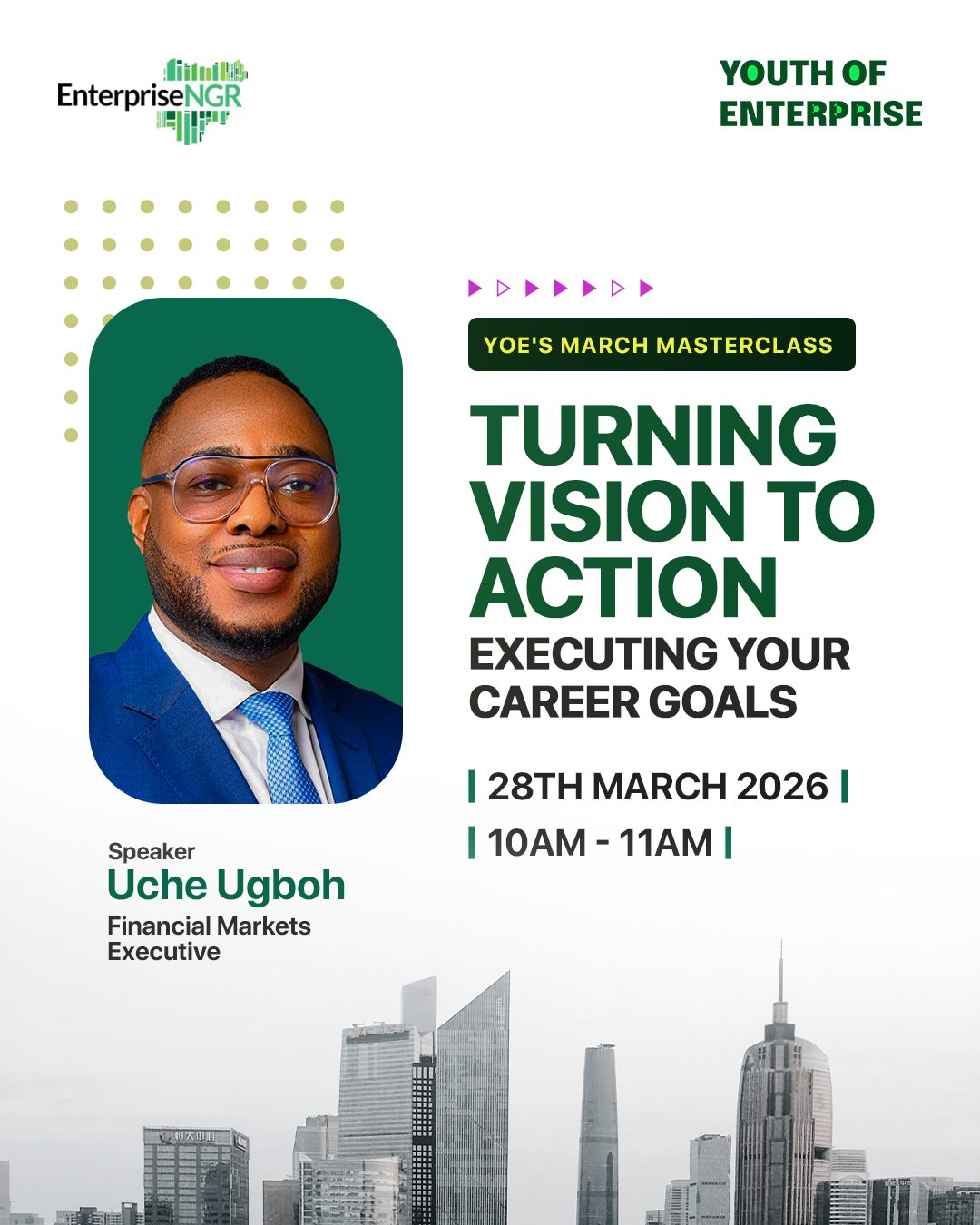
March 2026’s edition of the Youth of Enterprise (YOE) Masterclass focused on the theme “Turning Vision to Action: Executing Your Career Goals.” The session was led by seasoned financial markets expert, Mr. Uche Ugboh, who shared practical insights on how young professionals can bridge the gap between ambition and achievement. The session was highly interactive, with participants contributing personal career challenges and receiving tailored guidance. Mr. Ugboh emphasised that while connections may open doors, it is value, skill, and personality that sustain long-term success. The following are some of the key takeaways. How can you bridge the gap between vision and reality? Achieving career goals begins with clarity and honest self-assessment. Mr. Ugboh highlighted the importance of understanding your current position and what is required to reach your desired destination. Key steps include: Identify the Barrier: Recognise what is holding you back, whether it is lack of discipline, clarity, exposure, or resources. Define Industry Requirements: Every career path has entry requirements such as qualifications, certifications, or specific competencies. Map Your Development Gaps: Identify the technical and soft skills you need to acquire to progress. Prioritise Quality Over Elevation: Focus on building competence and readiness before seeking advancement. What practical steps can you take to execute your goals? In addition to strategic planning, Mr. Ugboh shared actionable steps to help participants begin their journey: Audit Your Strengths: Identify your natural abilities and consider how they can be applied within your chosen field. Invest in Technical Value: Develop in-demand skills through structured learning rather than relying solely on informal resources. Evolve Your Personality: As your career progresses, your mindset and interpersonal approach must also grow, especially when transitioning into leadership roles. Seek Mentorship: Guidance from experienced professionals can help you navigate challenges and make informed decisions. The importance of intentional action A key message from the session was that success is not accidental. It is the result of intentional effort and continuous value creation. Many professionals remain stuck not because they lack vision, but because they delay execution. Mr. Ugboh encouraged participants to move beyond long-term goal setting without action and instead focus on consistently closing their development gaps. In conclusion The March 2026 Masterclass was a powerful and thought-provoking session that challenged participants to take deliberate action towards their career goals. By combining self-awareness, skill development, and intentional execution, young professionals can transform their vision into tangible results.
Annual Members’ Retreat

The Annual Members’ Retreat offered an important moment for EnterpriseNGR’s members to come together, reflect on progress and help shape the next phase of the organisation’s journey. Held in conjunction with the Fifth AGM, it was a space for thoughtful engagement on priorities, direction and shared responsibility. What made the retreat especially significant was not just the agenda, but the quality of participation behind it, members showing up not only as stakeholders, but as active contributors to what EnterpriseNGR is building.